

DESALINATION
WATER INITIATIVES OTEC/SEATEC
What Is Ocean Thermal Energy Conversion (OTEC)?
The oceans cover a little more than 70% of the Earth’s surface. This makes them the world’s largest solar energy collector and energy storage system. On an average day, 60 million square kilometers (23 million square miles) of tropical seas absorb an amount of solar radiation equal in heat content to about 250 billion barrels of oil.
If less than one-tenth of one percent of this stored solar energy could be converted into electric power, it would supply more than 20 times the total amount of electricity consumed in the United States on any given day.
OTEC, or Ocean Thermal Energy Conversion, is an energy technology that converts solar radiation to electric power. OTEC systems use the ocean’s natural thermal gradient – the fact that the ocean’s layers of water have different temperatures – to drive a power-producing cycle. As long as the surface temperature between the warm surface water and the cold, deep water differs by about 20 degrees C. (36 degrees F.) an OTEC system can produce a significant amount of power (Carnot’s law).
The cold, deep seawater used in the OTEC process is rich in nutrients, and can be used to cultivate both marine organisms and plant life near the shore or on land which would produce sufficient fishing to pay for the investment as well as absorb massive amounts of CO2 as previously stated.
What Is Solar Energy Assisted Thermal Energy Conversion (SEATEC)?
OTEC cannot compete with SEATEC state-of-the-art technology for two principal reasons:
•Of the total cost, 40% of an OTEC fabrication expense is attributed to the placement of a cold water pipe to the bottom of the sea to obtain the temperature differential.
•Inappropriate turbine designs have been considered for energy recovery.
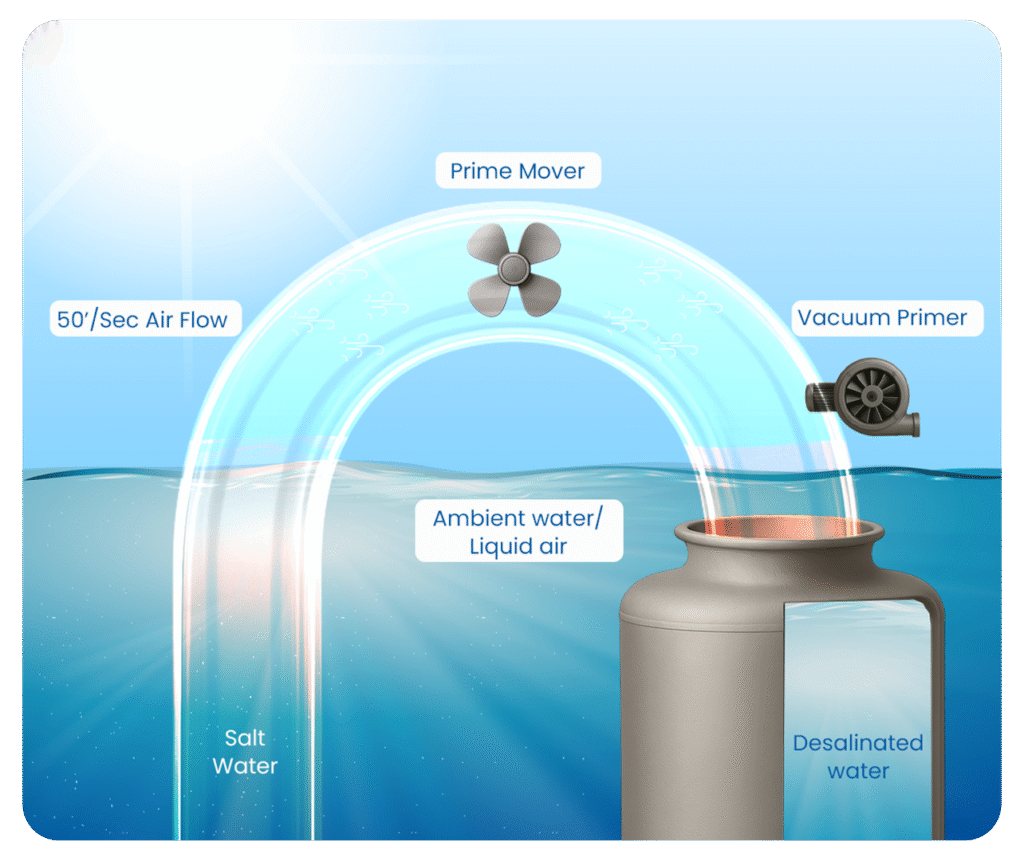
DragonsHeart is in possession of an advanced state-of-the-art turbine design appropriate to the application. SEATEC creates an excess of 100Fº, allowing the use of water at ambient temperatures to gain the temperature differential. While OTEC is 7% efficient, the SEATEC may well be over 35% efficient. In simple terms, the temperature differential can be utilized five times; a commercially viable reference point. Every degree increase in the differential increases the number of times the energy can be extracted. A new technology in making inexpensive liquid air/nitrogen can add new dimensions to the efficiency of this system.
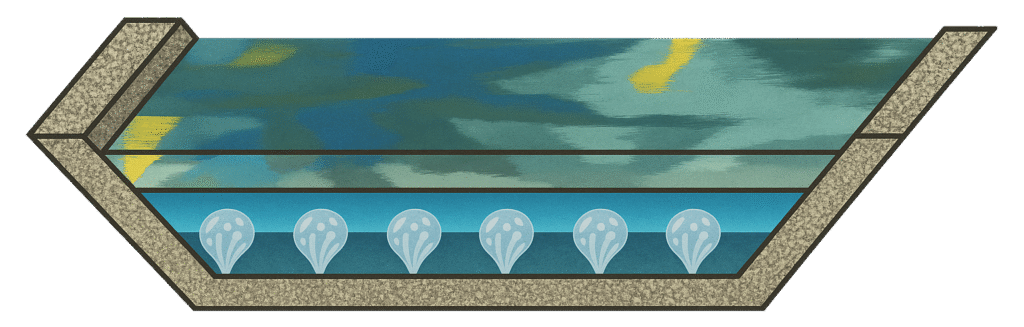
The novelty of this system lies in the layering of plastic sheets over water that acts as a medium for heat exchange of ambient water. The layers enhance induction and conduction, whereby 80% of the available solar heat is applied, whereas only 20% is reflected off the surface, rather than 80%.
Historically, plastic cannot be used for long in high solar intensity because of degradation, as can be seen by the yellowing plastic used in the desert greenhouses. A plastic that is not affected by UV has been tested in Arizona over a fifteen year period that has remained clear. It has not been recently available because of lack of a market.
Advantages to this system are two-fold:
•Theoretically, there is no limit to the scalability of this technology. This creates a desirable project funding platform for specific organizations of approximately $100-$200M+ per installation (100M producing 9 million gallons of fresh water per day, and creating 4Mw of electricity) and
•The technology is easily made mobile by container ship. This would have been practical in the Gulf War when an oil slick was heading toward the Saudi desalinization installations. Mobile SEATEC has imminent advantages for providing energy and water, while land-based SEATEC is being constructed for uses including: multiple desert irrigation schemes, which would benefit from occasional irrigation techniques, and emergency rescue situations for coastal area.
This technology would be a significant benefit for any organization focusing on disaster relief, such as Ships of Salvation.
TRIBOGENIC WATER REACTOR (TGR)
The vital compound for life and sustainable growth is water. In the environmental and life science sectors the technologies related to water retain crucial attention.
Our esteemed Senator Dr. Guy Montpetit, PhD., has developed the Triboelectric reactor, a technology for water treatment, conditioning & purification processes for commercial, industrial and government markets.
After fifteen years of R&D, the Triboelectric reactor has been developed based on the concepts of electrostatic inductions and magnetic molecular inhibitors in liquids. The technology for water treatment did not change much in the last century, and has mainly evolved only in the last 10 years with membrane filtration.
The Tribogenic Water Reactor or TGR, can not only replace chlorine or ozone for disinfection, but will produce healthier water rarely available in nature. The TGR is in a unique position to offer highly cost-effective treatment technologies capable of supplying a water quality never attained before. Whether it is clean water for manufacturing, high purity water for medical applications or just safe drinking water, the TGR has the opportunity to become a vital part of daily water purification, conditioning & treatment processes.
Apart from the obvious benefits as stated above, the TGR has the ability to desalinate water.
CHARACTERISTIC OF THE TRIBO ELECTRIC REACTOR
The electrostatic repulsion
The effect of the electrostatic repulsion on the ionized surfaces introduced by the electric induction makes it applicable to the following situations:
A. Protection of osmosis in the desalination of seawater
- The longevity of osmosis membrane in service could be multiplied by a very important factor
- The decrease in tension on the surface of the water should increase the debit of the membranes per surface unit.
B. Protection of ultra- filters and micro-filters in the treatment of drinking and used waters.
- Treatment of drinking water (municipalities and others).
- Water for injection into the (oil wells and treatment and ground water).
- Used water (manure etc).
The reactor has the capacity to clean waterways and pipes by the effect of electrostatic repulsion on the calcium deposit, rust and bio-films on the lining of the water pipes. The addition of an anti-parasite frequency transmission shall complete the vocation for this application. The elimination of bacterial contamination of water shall be the key for:
- Replacement of ultraviolet lamp.
- Treatment of legionnaire disease in hospitals, public buildings and hotel, etc.
- Cold pasteurization.
- Replacement of chemical treatment of water in the cooling towers.
- Suppression of bacterial growth in the injection wells.
We must learn to control this particularity by adding gas in order to increase it’s effect or neutralize the positive ions in order to control the effect.
- Accelerate the precipitation in the floatation application.
- Increase the penetration in solvents (water of other chemicals).
- Save water irrigation by reducing evaporation.
This aspect of the reaction with different gas is promising for the treatment of drinking water which contain H2S, waste waters or industrial and agricultural proceedings.
This property has already found application in the commercialization of oxygenated
- Conditioning of water for agriculture (addition of CO2) .
- Treatment of affluent.
- Treatment of industrial waste water (green water from paper mills) .
- Regeneration of rivers.
- Fish breeding.
- Addition of oxygen in water (laboratory testing necessary).
- Fixation of nitrogen in Ultrapure water of the electronic industry.
The anti-oxidization properties of the reactor are applicable in all type of business and
- Pharmaceutical (pure water conduct).
- Food (juice and other beverage).
- Electronics.
- Servers and water aqueduct.
- Waste and hard waters.
Estimated cost of each installation approximately USD 1.7 million providing thousands of gallons per day